
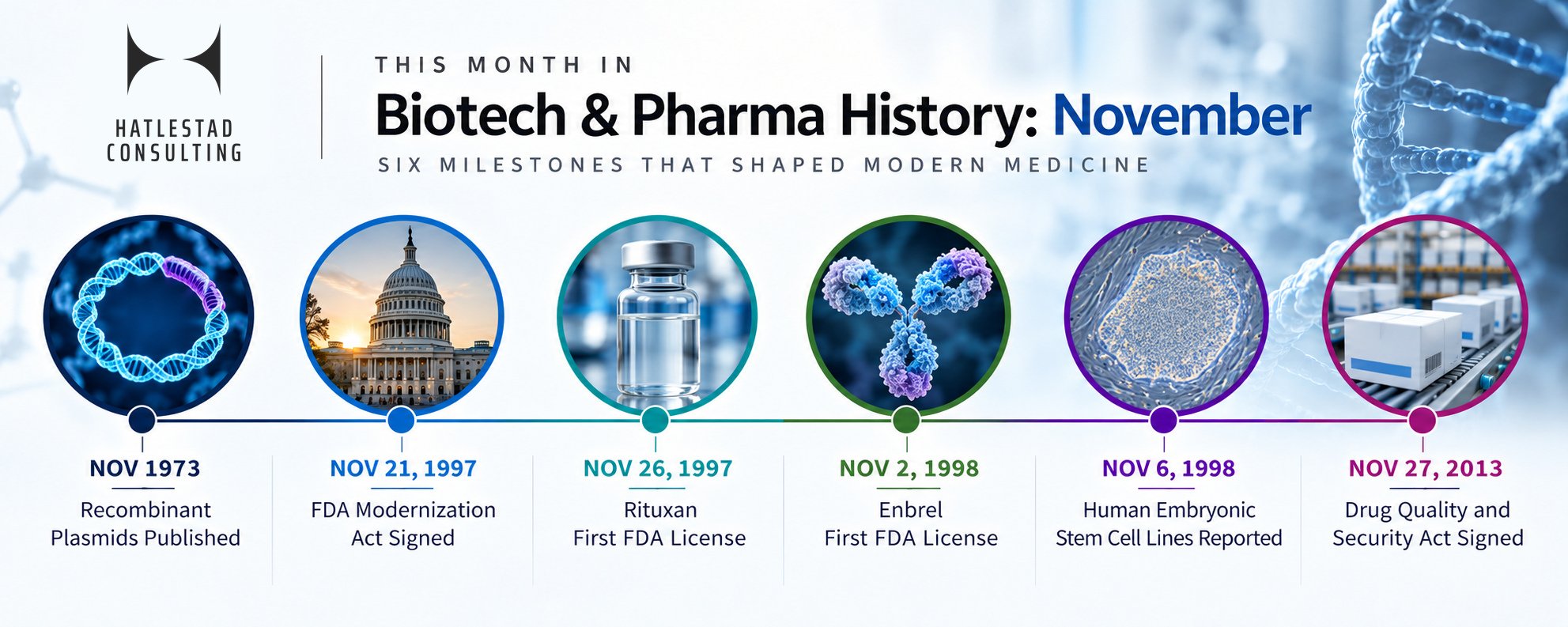
Six milestones that shaped modern medicine—and what they mean for quality today
ENovember has marked defining moments in biotechnology and pharmaceutical history, from the construction of recombinant plasmids to advances in biologic medicines and legislation addressing drug quality. These milestones show how scientific innovation expands what medicine can achieve—and the evidence and controls needed to support it. In this edition, we revisit six November milestones and explore their continuing relevance to GxP compliance, computerized systems, and data integrity.
🧬 November 1973 | Recombinant plasmids provide a foundation for DNA cloning
In the November 1973 issue of PNAS, Stanley Cohen, Annie Chang, Herbert Boyer, and Robert Helling described constructing biologically functional plasmids by joining DNA fragments in vitro. The recombinant plasmids functioned in Escherichia coli and carried properties from their parent DNA molecules. [1]
The researchers showed that DNA fragments could be joined into new plasmids and introduced into bacteria while retaining biological function. The achievement helped turn genetic engineering into a practical experimental method. This milestone is dated to the journal’s November issue; the publication record does not assign a specific day. [1].
Why it matters today: Recombinant medicines depend on well-characterized biological starting materials. Traceable records of cell substrate history and identity help connect development decisions with manufacturing use. ICH Q5D later provided guidance on production cell substrate derivation and characterization, reinforcing the importance of understanding the biological system behind a product [7].
🏛️ November 21, 1997 | FDA Modernization Act signed
The Food and Drug Administration Modernization Act of 1997 amended the Federal Food, Drug, and Cosmetic Act and reauthorized the Prescription Drug User Fee Act for another five years. Its provisions also addressed Fast Track development and review for qualifying drugs, reflecting efforts to improve regulatory efficiency while maintaining standards for medical products. [2, 11, 13]
The law also addressed biological product regulation and manufacturing changes. These provisions recognized the need for regulatory approaches that could keep pace with increasingly complex technologies. The historical milestone is the law’s enactment; individual provisions had their own implementation details. [2]
Why it matters today: Predictable development and review depend on complete, reviewable evidence. Quality teams support submission readiness through controlled documentation and clear links between requirements, study results, and decisions. For computerized systems supporting regulated activities, appropriate validation and data integrity controls help preserve that evidence throughout its lifecycle.
💉 November 26, 1997 | Rituxan receives its first FDA license
FDA licensed Rituxan (rituximab) for patients with relapsed or refractory low-grade or follicular B-cell non-Hodgkin lymphoma. This was the first monoclonal antibody FDA approved to treat cancer. The original license marked an important advance in the clinical use of targeted antibody therapy. [3]
The FDA’s approval letter shows how a therapeutic advance depended on a defined manufacturing arrangement and continuing quality commitments. It addressed shared manufacturing, stability studies, environmental monitoring, and support for fill duration. These details connect a product approval with the controls needed to supply it consistently. [3]
Why it matters today: Approval is the beginning of an ongoing responsibility to maintain product quality. Stability programs and reliable analytical methods support confidence in shelf life, while controlled manufacturing changes help preserve product consistency. The original Rituxan letter provides a concrete historical example of these continuing commitments. [3, 8]
📋 October 29, 1992 | Prescription Drug User Fee Act Signed
The Prescription Drug User Fee Act (PDUFA) established a framework allowing the FDA to collect application fees from pharmaceutical manufacturers to support drug reviews.
The legislation introduced performance goals that helped improve the predictability and efficiency of the regulatory review process.
Why it matters today: Regulatory review timelines reinforce the importance of submission readiness, complete documentation, and effective quality systems to minimize avoidable delays.
🧪November 6, 1998 | Human embryonic stem cell lines reported
James Thomson and colleagues published “Embryonic Stem Cell Lines Derived from Human Blastocysts” in Science. They described pluripotent human cell lines that retained the capacity to form derivatives of the three embryonic germ layers after prolonged culture. This was a research milestone that expanded possibilities for studying human development and disease. [5]
The publication described human blastocyst-derived cell lines that could continue proliferating while retaining developmental potential. It opened opportunities for studying early development and exploring applications in drug discovery and regenerative medicine. It was a research publication, rather than approval of a clinical treatment. [5]
Why it matters for quality today: Living systems make provenance and reproducibility especially important. Documenting cell identity, culture conditions, passage history, and relevant testing helps teams interpret variability and reconstruct results. As research moves toward clinical use, controls must reflect the intended use and development stage.
🔬 November 2, 1998 | Enbrel receives its first FDA license
FDA first licensed Enbrel (etanercept), a therapeutic fusion protein that inhibits tumor necrosis factor. Its development extended biotechnology’s role in treating inflammatory disease. FDA later confirmed November 2, 1998 as the product’s date of first licensure. [4, 12]
Etanercept combines a tumor necrosis factor receptor component with the Fc portion of human IgG1. Its engineered structure illustrates how biotechnology can create medicines with different formats and functions. The November date records original licensure, rather than a later indication or presentation. [4, 12]
Why it matters today: Manufacturing processes evolve as equipment, facilities, and methods improve. ICH Q5E provides a framework for assessing biological product comparability before and after manufacturing changes. Planning the assessment early and choosing methods that detect meaningful differences connect innovation with effective change control. [8]
🏛️ November 27, 2013 | Drug Quality and Security Act signed
Title I, The Drug Quality and Security Act became law. Its compounding provisions created section 503B and the outsourcing facility framework. Title II, the Drug Supply Chain Security Act, established provisions for tracing certain prescription drugs through the U.S. drug supply chain. The two parts addressed different vulnerabilities in the availability of dependable medicines. [6, 9]
The compounding reforms followed the 2012 fungal meningitis outbreak associated with contaminated compounded medicines. The supply chain title addressed another part of patient protection: identifying and tracing covered prescription products as they move through distribution. The 2013 enactment date is distinct from subsequent implementation deadlines and exemptions. [6, 9]
Why it matters today: Supplier qualification and dependable records remain essential patient protections. Section 503B outsourcing facilities are subject to CGMP requirements, and registration does not establish FDA approval of their compounded drugs or confirm compliance. Supply chain controls also depend on accurate product information and effective procedures for investigating suspect products. [9, 10]
Looking Ahead | Innovation and quality advance together
From foundational DNA research to legislation addressing compounding and distribution, each milestone brought new possibilities and new quality responsibilities. For emerging biotech and pharmaceutical companies, building traceability, change control, and dependable records into development can support the transition from promising science to consistent operations.
Understanding the milestones that shaped our industry helps us prepare for the quality and regulatory challenges of tomorrow.
At Hatlestad Consulting, we help emerging biotechnology, pharmaceutical, and medical device companies establish practical, scalable quality systems through GxP compliance, computerized system validation, computer software assurance, and data integrity solutions.