
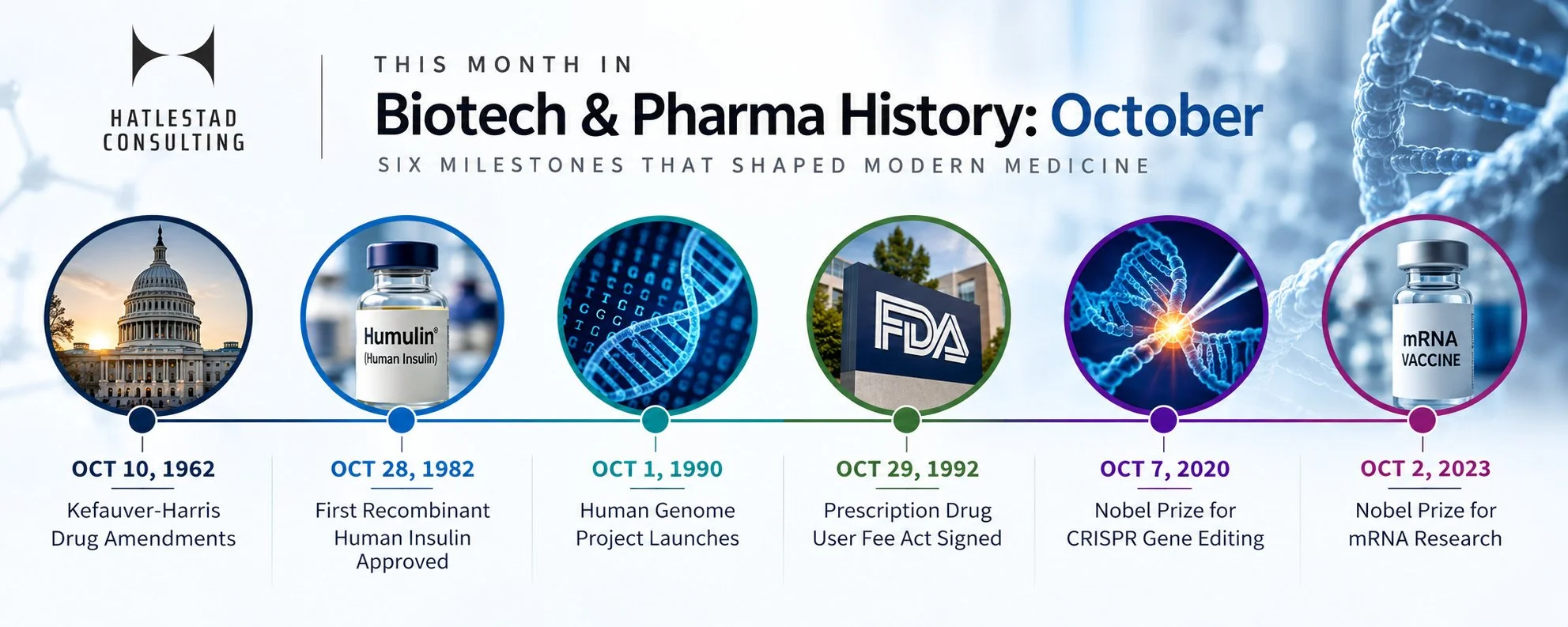
What do drug safety legislation, genetically engineered insulin, and the Human Genome Project have in common?
Each represents a turning point in biotechnology and pharmaceutical history that continues to influence how medicines are developed, manufactured, and regulated today.
October marks several important milestones that helped shape the life sciences industry and the quality standards we rely on.
Here's a look at six significant events and why they still matter.
🏛️ October 10, 1962 | Kefauver-Harris Drug Amendments
Signed into law by President John F. Kennedy following growing concerns about drug safety and the thalidomide tragedy, these amendments transformed pharmaceutical regulation in the United States.
The legislation required manufacturers to demonstrate both the safety and effectiveness of new drugs before FDA approval. It also strengthened clinical research oversight, informed consent requirements, and manufacturing controls.
Why it matters today: These amendments helped establish the foundation for modern pharmaceutical quality systems, GMP compliance, and the expectation that drug approvals must be supported by reliable scientific evidence.
💉 October 28, 1982 | First Recombinant Human Insulin Approved
The FDA approved Humulin, the first therapeutic product manufactured using recombinant DNA technology.
Developed through pioneering research by Genentech and City of Hope and commercialized by Eli Lilly, Humulin demonstrated that genetically engineered medicines could be manufactured successfully at commercial scale.
Why it matters today: This milestone helped establish the modern biotechnology pharmaceutical industry and advanced manufacturing practices involving process validation, contamination control, and product consistency.
🧬 October 1, 1990 | Human Genome Project Launches
The Human Genome Project officially began its mission to map and sequence approximately three billion DNA base pairs in the human genome.
Completed in 2003, the project accelerated genetic research and helped establish the foundation for modern genomic medicine, targeted therapies, and personalized treatments.
Why it matters today: Genomic medicine depends on accurate, reliable, and traceable data. When genomic technologies support GxP-regulated activities, data integrity and appropriate computerized system validation and assurance practices are essential.
📋 October 29, 1992 | Prescription Drug User Fee Act Signed
The Prescription Drug User Fee Act (PDUFA) established a framework allowing the FDA to collect application fees from pharmaceutical manufacturers to support drug reviews.
The legislation introduced performance goals that helped improve the predictability and efficiency of the regulatory review process.
Why it matters today: Regulatory review timelines reinforce the importance of submission readiness, complete documentation, and effective quality systems to minimize avoidable delays.
🔬 October 7, 2020 | Nobel Prize Recognizes CRISPR Gene Editing
Emmanuelle Charpentier and Jennifer Doudna received the Nobel Prize in Chemistry for developing CRISPR-Cas9 gene-editing technology.
Their work opened new possibilities for treating genetic diseases and helped pave the way for the FDA's first approval of a CRISPR-based therapy in December 2023.
Why it matters today: Gene-editing technologies introduce complex manufacturing, testing, and traceability requirements, emphasizing the need for robust quality systems and risk-based controls.
🧪 October 2, 2023 | Nobel Prize Recognizes mRNA Research
Katalin Karikó and Drew Weissman received the Nobel Prize in Physiology or Medicine for discoveries involving nucleoside base modifications that enabled effective mRNA vaccines.
Their research contributed to the rapid development of COVID-19 vaccines and expanded opportunities for mRNA-based therapeutics.
Why it matters today: Emerging therapeutic platforms require quality systems capable of supporting innovation while maintaining manufacturing consistency, data integrity, and regulatory compliance.
Looking Ahead
From the introduction of modern drug efficacy requirements to the development of advanced genetic therapies, these milestones demonstrate how scientific innovation and pharmaceutical quality have evolved together.
Understanding the milestones that shaped our industry helps us prepare for the quality and regulatory challenges of tomorrow.
At Hatlestad Consulting, we help emerging biotechnology, pharmaceutical, and medical device companies establish practical, scalable quality systems through GxP compliance, computerized system validation, computer software assurance, and data integrity solutions.